

First 5 Days
How to Start Pilates at Home With No Equipment
The most common thing that puts people off starting Pilates is the idea that they need something they do not have yet. They do not.
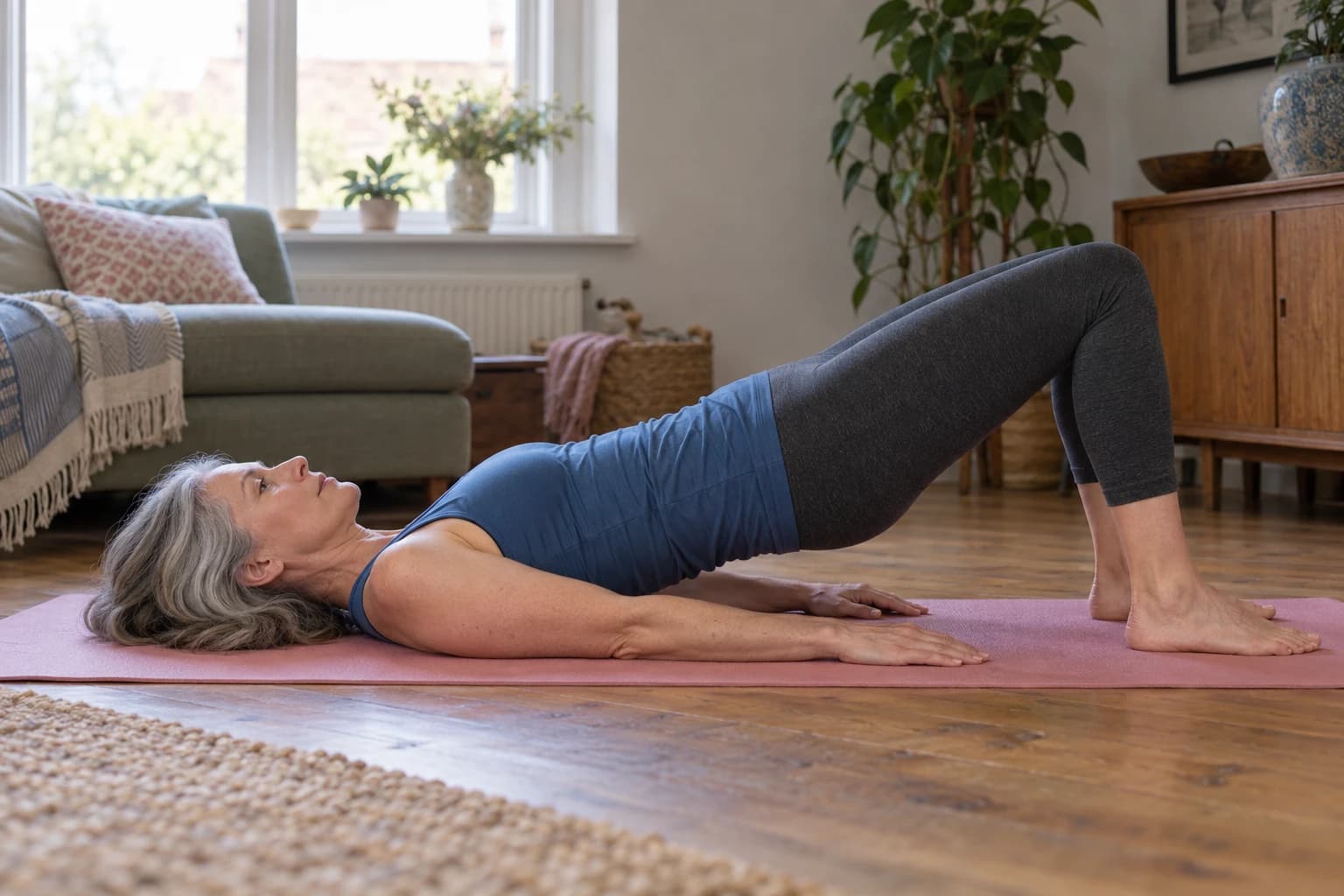
The most common reason people delay starting Pilates is the idea that they need something they do not have yet. A reformer machine. A studio. A mat that costs £80. They do not.
Classical mat Pilates, the foundation of the method, requires only a firm surface and enough floor space to lie down. Today, an inexpensive Pilates mat helps with grip and comfort. That is genuinely all you need to begin.
What home Pilates actually looks like
For your first few sessions, you will spend most of your time on the floor. You will lie on your back, your side and occasionally your front. You will sit up, and sometimes kneel. The exercises use your own bodyweight and are controlled, not fast.
Good beginner Pilates focuses on how you move, not how much you can do. The first exercises you learn are usually about breathing, finding a neutral position in your pelvis and spine, and learning how to connect to your core without gripping. This is not advanced, rather the foundation everything else builds on.
How much space do you need?
You need enough room to lie down and extend your arms above your head. A clear area of roughly two metres by one metre is enough for most mat work. A bedroom floor, a living room with furniture pushed aside, or a kitchen all work perfectly well.
A starting point
If you want to try a few movements before committing to a full session, here are three foundations to begin with.
Breathing with rib expansion: lie on your back with your knees bent and feet flat on the floor, hip-width apart. Rest your hands lightly on the sides of your ribcage. Breathe in slowly through your nose and feel your ribs widen sideways into your hands. Breathe out through your mouth and feel them drop. As you do this try to gently pull your tummy in. Repeat six times. Notice whether you are lifting your shoulders or whether the movement stays in your ribs.
Pelvic tilt: in the same position lying down position. You breathe in as you gently rock your pelvis so your lower back presses lightly into the floor, then breathe out to return. This is a small movement and really gives the lower back a nice stretch. You are not lifting your hips off the floor. Repeat eight times.
Knee folds: from the same starting position, breathe in to prepare. As you breathe out, lift one foot off the floor so your knee floats up toward the ceiling, keeping your pelvis still. Breathe in at the top, then breathe out to lower. Alternate legs for ten repetitions in total.
What you do not need
You do not need a reformer to begin Pilates. Reformer machines are a progression tool, not an entry requirement. Many experienced practitioners never use one and find mat work challenging enough to sustain years of practice.
You do not need to be flexible. Pilates is not yoga or gymnastics. You will find exercises that suit where you are right now.
You do not need expensive activewear. Comfortable clothing you can move in is all that matters. If you are using a mirror to check your form, you should avoid really loose clothing, so that you can see how your body moves.
The most useful thing you can do
Follow guided instruction rather than copying movements from memory. Pilates exercises look simpler than they are, and the detail is in what you cannot see from watching someone else. A session with clear cueing, even a short one, will teach you more in ten minutes than an hour of guessing.
Try it on Pathway
Start with First 5 Days: five free sessions built for people who have never done Pilates before (or want to begin again from scratch).
No equipment, no assumed knowledge, no pressure to keep up. Work at your own pace on your own schedule.
Go to First 5 Days